We are preparing for longer lives, but still judging ourselves by shorter beauty scripts. The longevity era has stretched the human timeline, yet our aesthetic imagination remains strangely young: smoother, tighter, untouched, edited. But if we are going to live longer, work longer, love longer, and reinvent ourselves across more decades, beauty has to evolve too. The deeper question is how to let the outside keep faith with the life still unfolding inside.
Longevity is often framed as a numbers game: more years, younger biomarkers, fewer visible signs of decline. A life resists the spreadsheet logic of optimization; a face carries history, not defects. The deeper promise of longevity is the chance to remain deeply present within time, rather than staging a permanent escape from it. Beauty, then, becomes less about preservation and more about alignment: the outer expression of a life still animated by vitality, character, and choice.
Psychologist Vivian Diller, author of Face It: What Women Really Feel As Their Looks Change, has written about the emotional complexity of watching one’s appearance change over time. That complexity is often dismissed as vanity. It is not. The face is one of the ways we are recognized by others, and by ourselves. When it changes, something deeper than skin is involved: identity, confidence, social visibility, and the quiet question of whether the person in the mirror still feels like “me.” This is where beauty becomes more than aesthetics. It becomes adaptation. In a longer life, we need a definition of beauty broad enough to hold vitality, character, sensuality, intelligence, and age. Not as consolation prizes after youth has left the room, but as dimensions of presence that become more interesting with time.
Philosopher Crispin Sartwell offers a useful bridge from psychology to aesthetics: beauty exceeds symmetry, smoothness, and youth; it lives in the quality of presence a person brings into view. The most compelling faces are rarely flawless. They carry humor, appetite, grief, intelligence, desire, and continuity. They show a person who has been in conversation with life, not sealed off from it. With age, beauty shifts registers; the body begins to carry depth, continuity, and lived intelligence.
Look Great, Not Fake: A New Era of Aesthetic Integrity
This is where the conversation gets more interesting. Aesthetic aging is no longer simply a matter of taste; it sits at the intersection of biology, psychology, technology, and identity. Skin changes are not imaginary. In the first five years after menopause, women lose roughly 30% of their skin collagen, followed by about 2% per year thereafter. The mirror is reporting biology, not moral failure.
At the same time, the aesthetic industry is expanding because people are not opting out of appearance. They are asking for better authorship over it. In 2024, minimally invasive treatments remained a dominant part of aesthetic medicine, with neuromodulators such as Botox still the leading category. The cultural question is no longer whether people will intervene. They already do. The better question is whether those interventions support vitality or manufacture sameness.
That is why “look great, not fake” is more than a clever phrase. It names the new standard: enhancement without erasure, refinement without distortion, care without surrendering the face to fear. Aesthetic integrity means choosing interventions that keep the person recognizable to herself. Less mask. More signal.
This is the new art of aging: subtle enhancement in service of alignment. The goal is to let how we look remain in honest conversation with how we feel: strong, vibrant, sensual, capable, and at peace with the years we have lived. In the longevity era, the vanity mirror becomes more than a private beauty ritual. It becomes a site of authorship, where identity, biology, self-expression, and intention meet before we step back into the world.
A Longevity Intelligence Lens on Beauty
This is where Longevity Intelligence enters the mirror. I developed LI as a framework for living wisely across longer, faster, more complex lives, where biology, technology, and social identity no longer move in separate lanes. Applied to aesthetics, it asks a sharper question: how do our choices about appearance strengthen agency, coherence, vitality, and self-expression across time? Aesthetic care becomes more than maintenance. It becomes one of the ways a woman remains visible to herself, intelligible to others, and in authorship of the life she is still building.
Longevity Intelligence gives aesthetics a larger frame: appearance becomes one part of the living system of a woman’s body, identity, confidence, and social presence. How we look shapes how we feel in the body, how we move through the world, how we are read by others, and how much permission we give ourselves to remain visible. In that sense, aesthetics becomes a feedback loop. The biological self wants vitality. The psychological self wants recognition. The social self wants belonging without performance. When those layers are aligned, beauty stops being a chase and becomes a form of coherence: the outer expression of a life still engaged, still adaptive, still in authorship.
Through a Longevity Intelligence lens, aesthetics lives across three terrains: biological, digital, and social. Beauty becomes a systems question with a surface expression.
- In the biological domain, the face is part of the body’s larger intelligence. Hormonal shifts, collagen loss, inflammation, sleep, stress physiology, muscle tone, and metabolic health all shape how vitality appears. Skin is a canvas, but also a living record of biology. After menopause, for example, women can lose roughly 30% of skin collagen in the first five years, followed by about 2% per year thereafter. That fact alone should move the conversation from shame to science. The mirror is usually seen as reporting failure, but it is actually reporting a system asking for intelligent support.
- In the digital domain, beauty now lives inside a distorted hall of mirrors. Filters, AI editing, algorithmic comparison, and “Instagram face” have trained millions of women to compare their living faces to synthetic ones. This is where aesthetic integrity becomes a form of cognitive sovereignty: choosing enhancement from authorship rather than algorithmic pressure. The future of beauty has been defined for too long by better devices, sharper diagnostics, and more precise interventions. Its deeper test is whether women can still recognize themselves inside the technologies shaping desire.
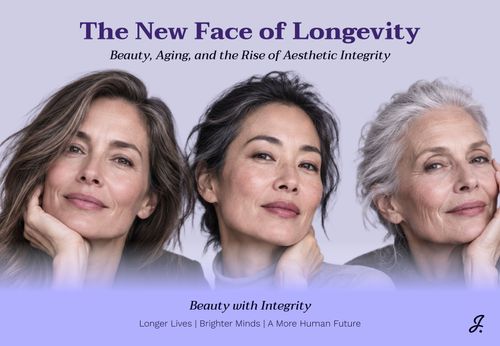
- In the social domain, beauty becomes intergenerational. We need women in their 30s, 50s, 70s, and 90s visible in the same cultural conversation, instead of arranged in a silent hierarchy where youth gets the spotlight and age gets the footnote. Here, even laugh lines deserve a better story. The world may read them as wrinkles, but the laughter that made them may have been doing quiet biological work: reducing stress chemistry, strengthening social bonding, and helping the body recover from strain. A meta-analysis found spontaneous laughter associated with reduced cortisol, and social laughter has been linked with elevated pain thresholds, a proxy for endorphin release. So perhaps the line on the face is not the damage. Perhaps it is the receipt from a life that knew how to connect.
This is Longevity Intelligence in practice. It is how we build future-ready human capability through the everyday choices that shape health, identity, technology, relationships, and self-expression. People often ask where a framework like this shows up in ordinary life. The answer is: everywhere we are asked to make choices across time. In our health. In our technologies. In our relationships. And yes, in the mirror. Aesthetics may seem like a small arena, but it reveals the larger pattern: how we use science without surrendering judgment, how we adopt technology without losing self-recognition, and how we remain visible in a culture still learning how to honor long lives.
I come to this conversation as a scientist by training, an investor by experience, an athlete by discipline, and a woman deeply interested in how we preserve agency across time. My work sits at the intersection of health, technology, and human potential, and Longevity Intelligence is my way of translating that intersection into a usable lens for modern life. In aesthetics, that lens asks us to choose with intention: to care for the body without chasing sameness, to use interventions without erasing identity, and to let beauty become an expression of vitality, self-knowledge, and authorship.
The more interesting question is: How do I want to show up in the world at every stage of life?