
Body Wellness & HealthLongevity Medicine & Biotech
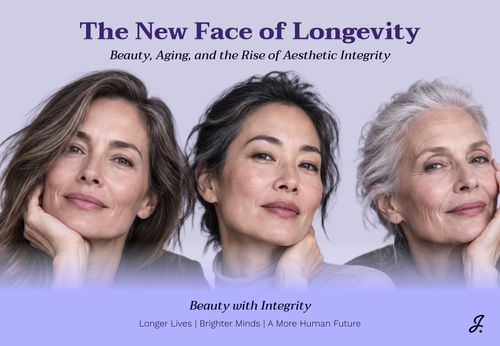
The New Face of Longevity: Beauty, Aging, and the Rise of Aesthetic Integrity
Rethinking beauty, aging, and aesthetic choices in the longevity era.
November 22, 2026 by Jasmina Denner
Share:
Why AI's Growing Capabilities Raise the Stakes for Human Development, By Jasmina Denner, PhD
Imagine asking an AI agent to evaluate a proposal, compare the evidence, and recommend a decision. Minutes later, it delivers a persuasive analysis. You still have the authority to approve it. But can you question its assumptions, identify what it overlooked, or recognize when its recommendation deserves to be rejected? On September 18, 2026, AI pioneer Fei-Fei Li offered a concise distinction:
“Agents can be AI, but agency is human.”
Her observation establishes an important principle. It also raises a deeper question: What does it take to exercise meaningful human agency when increasingly capable systems can act on our behalf? We are investing extraordinary resources in developing machines that can reason, plan, and execute tasks. We measure their progress through increasingly sophisticated benchmarks and productivity gains. Yet the development of the humans using these technologies receives considerably less attention. This creates a paradox at the heart of technological progress: Our ability to accomplish more with AI may expand faster than our capacity to understand, judge, and direct what we accomplish.
The OECD's Digital Education Outlook 2026 warns that impressive AI-assisted results can create a mirage of false mastery. A completed task demonstrates what a human–AI system achieved. It may reveal little about what the human learned. A 2025 experiment involving nearly 1,000 high-school mathematics students made that distinction visible. Students using an unrestricted GPT-based assistant scored 48% higher on practice problems, yet performed 17% worse than students without AI assistance on a subsequent independent examination. A differently designed tutor, which guided students with hints, largely avoided this disadvantage.
Another study offers a more encouraging possibility. In a randomized experiment involving 194 university physics students, researchers found that a purpose-built AI tutor produced greater immediate learning gains than a comparison active-learning classroom, in less time. These findings suggest that the design of human–AI interaction can influence whether technological assistance strengthens learning or allows people to bypass it.
The concern extends beyond education. In a 2025 Microsoft Research and Carnegie Mellon study, 319 knowledge workers described 936 instances of using generative AI. Greater confidence in AI was associated with less self-reported critical-thinking engagement, while greater confidence in one's own abilities was associated with more. A 2026 Anthropic experiment involving 52 software developers also found lower short-term knowledge-assessment scores among participants using AI assistance. Those who used AI to seek explanations and develop understanding often demonstrated stronger mastery than participants who primarily delegated code generation.
These studies examine particular tasks, populations, and short-term outcomes. They do not establish a general decline in human intelligence or agency. Their significance lies in the distinction they reveal: Improved task performance and the development of independent human capability are separate outcomes. Understanding their relationship is becoming an important scientific and societal question.
More than two decades before agentic AI entered public conversation, psychologist Albert Bandura offered a useful framework for understanding how people exercise agency. In his 2001 work on social cognitive theory, Bandura distinguished among personal agency, proxy agency, and collective agency. Personal agency involves acting directly through our own capacities. Proxy agency allows us to achieve goals through others who possess expertise or resources. Collective agency emerges through coordinated human effort. Bandura recognized that relying on intermediaries could expand our influence while also affecting opportunities to develop our own competencies.
His original account concerned human social relationships. Extending this perspective to AI agents introduces a new and consequential application. Intelligent systems are becoming powerful technological proxies. They can expand access to expertise, help people overcome practical barriers, and enable undertakings previously beyond an individual's reach.
Delegating tasks can itself be an expression of agency. The developmental question concerns the person exercising that delegation. Can they establish meaningful objectives and evaluate the system's recommendations? Do they understand the tradeoffs? Can they intervene when circumstances change? Keeping a human formally in the loop provides an opportunity for oversight. Exercising that oversight requires understanding and judgment. And those capacities develop within social conditions. Education, workplace expectations, and technological design influence whether people have the knowledge and opportunities necessary to exercise meaningful choice.
The quality of human agency depends partly on how delegation is structured, understood, and governed.
This question becomes especially consequential when viewed across a longer life. We may experience multiple careers, changing biological circumstances, and repeated technological transformations. Skills that once provided independence may become automated. New tools may expand possibilities we could barely imagine a decade earlier. The central developmental challenge is our continuing ability to learn, recalibrate, and participate meaningfully as these conditions evolve. This is one of the questions behind my work on Longevity Intelligence™.
Longevity Intelligence proposes four related developmental capacities: Agency, Coherence, Adaptability, and the Ability to Evolve. Together, they offer a framework for examining how people direct action, integrate experience, revise their responses, and participate deliberately in their own development across time. The framework remains a science-informed proposition whose integrated effects require further investigation.
Applied to our relationship with AI, it opens a question with implications extending well beyond workplace productivity: Are the technologies we use helping us develop the capacities we will need for the next chapter of life?
Consider a professional who uses AI to complete a complex analysis in half the time. Their productivity has improved. The combined human–AI system has achieved more with fewer resources. This is a genuine form of technological progress.
But how do we evaluate what has happened to the person?
Did the experience strengthen their understanding?
Can they apply what they learned to an unfamiliar problem?
Are they better prepared to recognize a consequential error?
And beyond competence, has the experience expanded their ability to exercise meaningful choice over the direction of their work and life?
These questions reveal different dimensions of progress.
Productivity measures the efficiency with which useful outcomes are produced. AI-augmented performance describes what becomes possible when human and technological capabilities work together. Human capability development concerns the knowledge, judgment, and competencies people acquire and retain. Human agency concerns our capacity to use those abilities, together with the resources and opportunities available to us, to shape meaningful outcomes.
These dimensions can reinforce one another. Productivity gains may create time for learning. Intelligent tools can make expertise accessible and enable people to overcome limitations. Thoughtful technological design can support the development of human capability. Yet greater computational power alone cannot tell us how people are developing. The opportunity ahead is to expand our understanding of progress. Alongside technological benchmarks and productivity measures, we need to examine how human knowledge, judgment, and developmental capacity evolve through sustained interaction with intelligent systems.
In a world of longer lives and expanding possibility, this question acquires a longer horizon. What we develop today influences our capacity to navigate the possibilities of tomorrow. The next great challenge of artificial intelligence concerns what using these technologies enables us to become.
As our machines acquire greater capacity to act, the development of human agency deserves a central place in how we understand and measure progress.
Rethinking beauty, aging, and aesthetic choices in the longevity era.
Why You’re Not Done Becoming—Even If You Think You Are We’ve all felt it: “This is who I am now. I’ve figured myself out.” It feels stable, satisfying… final. But psychology tells us something else: That’s an illusion. A powerful one. And it has a name.
A silent collapse is unfolding inside America’s universities—and it’s not just an academic trend. It’s a wake-up call. According to The Atlantic (June 2025), computer science enrollments are falling by 20–25% at several top institutions. After years of explosive growth, the CS boom is slowing fast. Why? Because AI is writing the code now.
“That brain of mine is something more than merely mortal, as time will show.” — Ada Byron, Lady Lovelace Centuries before artificial intelligence, before personalized medicine, before the words “data scientist” meant anything at all—Ada Lovelace imagined a world no one else could see.
Digital Health Demands a New Kind of Intelligence In an era where AI can personalize your meal plan, influencers recommend daily biohacks, and longevity advice spreads at the speed of a swipe, one thing has never been more urgent: your ability to think clearly and skeptically.
How Blockchain + AI Will Revolutionize Longevity—and Put Your Health Data Back in Your Hands Let’s start with the fear: You’ve lived a life, tracked your steps, logged your meals, taken your meds, uploaded your labs—and now your data is working against you. Your insurance rates rise. Your coverage is questioned. Your personal history—deeply human and deeply contextual—is treated like a pricing algorithm.