Body Wellness & HealthLongevity Medicine & Biotech
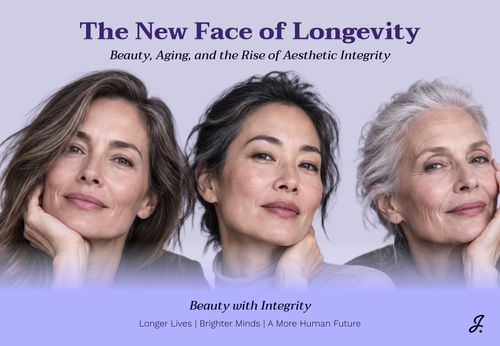
The New Face of Longevity: Beauty, Aging, and the Rise of Aesthetic Integrity
Rethinking beauty, aging, and aesthetic choices in the longevity era.
January 4, 2025
Share:
“In the end, it’s not the years in your life that count, it’s the life in your years,” Abraham Lincoln famously said. But what happens when those years stretch not just into decades—but into centuries?
Welcome to the existential gym, where building purpose is no longer a philosophical luxury—it’s a longevity essential!
Dr. Laura Carstensen, Stanford’s pioneering longevity researcher, suggests we think like athletes in training. If life is now an ultra-marathon, then psychological resilience is our most vital form of strength. The further the finish line moves, the more we need meaning to keep pace.
Building on that, philosopher Dr. Martha Nussbaum adds a moral and civic dimension. Her capabilities approach urges us to move beyond mere survival toward a flourishing life—one that includes creativity, emotional depth, and contribution to society. As lifespans extend, so too must our capacity to imagine new goals, embrace change, and find evolving forms of fulfillment.
But here’s the challenge: how do we keep our story compelling when it’s longer than War and Peace?
Enter Dr. Eric Kim, a behavioral scientist at the University of British Columbia, whose groundbreaking research connects purpose to healthspan in clear, measurable ways. His studies show that individuals with a strong sense of purpose are:
• 2.4 times less likely to die over a 9-year period
• 22% less likely to experience a stroke
• 26% less likely to develop sleep disorders
• And even 41% less likely to develop Alzheimer’s disease
Dr. Kim’s research makes one thing abundantly clear: purpose isn’t just a mindset—it’s a biological force multiplier!
It acts as a buffer against stress, a motivator for healthy behaviors, and a compass for navigating life’s complexity. Purpose helps us heal, focus, and stay grounded—not just emotionally, but physiologically. It enhances everything from cardiovascular function to cognitive resilience.
In short, if you want to live long, live with purpose.
So how do we keep our personal story alive and vibrant when the chapters just keep coming?
Treat your extended life like a never-ending Netflix series:
• Keep introducing fresh plotlines
• Invite new characters
• Embrace cliffhangers and plot twists
• Let your values evolve as the seasons change
Find new goals. Nurture new relationships. Contribute in new ways. Don’t just age—expand.
By season 100, you might just reinvent what it means to be human!
This is exactly the frontier that Longevity Intelligence is designed to explore. As a framework I’ve developed, LI redefines what it means to thrive in a world of exponential lifespans, digital acceleration, and human evolution.
Rather than focusing only on lifespan extension, LI explores how to live longer with vitality, adaptability, and direction. And at its core, purpose is not a side note—it’s a central driver across all three domains:
• Biological: Purpose reduces inflammation, promotes neuroplasticity, and supports longevity biomarkers
• Digital: Purpose guides how we engage with technology and how we filter the flood of digital noise into meaningful action
• Social: Purpose connects us—across generations, communities, and cultures. It becomes the legacy we build, not just the life we live.
As a visionary leader at the intersection of health, technology, and human potential, I believe the true opportunity of longevity isn’t just adding years to our lives—but adding depth, direction, and delight to those years.
The question isn’t whether we’ll live longer.
The question is: How will we make it matter?
So here’s your mission, should you choose to accept it:
If you knew you had another 60, 80, or 100 years—
What would keep your story not just going, but growing?
The time to start is now.
Rethinking beauty, aging, and aesthetic choices in the longevity era.
Why You’re Not Done Becoming—Even If You Think You Are We’ve all felt it: “This is who I am now. I’ve figured myself out.” It feels stable, satisfying… final. But psychology tells us something else: That’s an illusion. A powerful one. And it has a name.
A silent collapse is unfolding inside America’s universities—and it’s not just an academic trend. It’s a wake-up call. According to The Atlantic (June 2025), computer science enrollments are falling by 20–25% at several top institutions. After years of explosive growth, the CS boom is slowing fast. Why? Because AI is writing the code now.
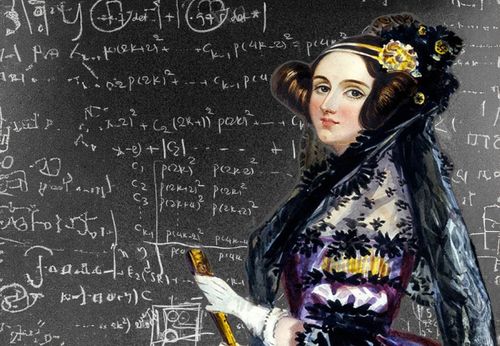
“That brain of mine is something more than merely mortal, as time will show.” — Ada Byron, Lady Lovelace Centuries before artificial intelligence, before personalized medicine, before the words “data scientist” meant anything at all—Ada Lovelace imagined a world no one else could see.
Digital Health Demands a New Kind of Intelligence In an era where AI can personalize your meal plan, influencers recommend daily biohacks, and longevity advice spreads at the speed of a swipe, one thing has never been more urgent: your ability to think clearly and skeptically.
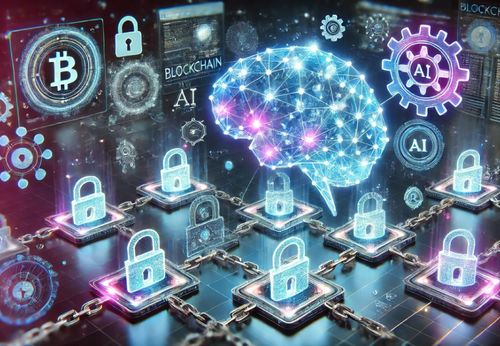
How Blockchain + AI Will Revolutionize Longevity—and Put Your Health Data Back in Your Hands Let’s start with the fear: You’ve lived a life, tracked your steps, logged your meals, taken your meds, uploaded your labs—and now your data is working against you. Your insurance rates rise. Your coverage is questioned. Your personal history—deeply human and deeply contextual—is treated like a pricing algorithm.